
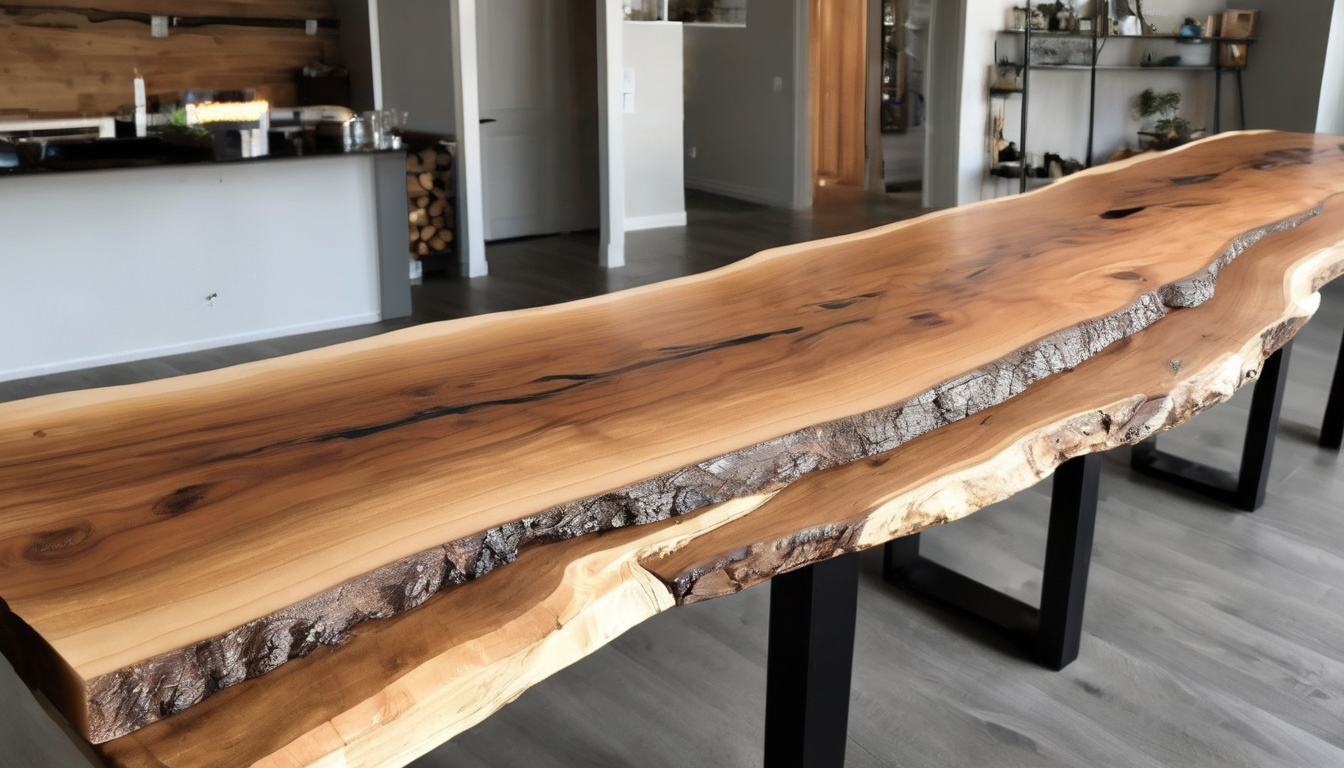

Creating a live edge resin river kitchen island starts with a single crucial decision: choosing the right timber slab. How to Choose Timber Slabs for Live Edge River Tables affects structural stability, appearance, and how the resin interacts with the wood. This step‑by‑step guide walks you through the entire selection process so you end up with a slab that’s visually stunning, structurally sound and suited to a busy kitchen in Bristol, Bath or anywhere across the South West of England.
Understanding How to Choose Timber Slabs for Live Edge River Tables
Before you buy, it helps to know exactly what a river table requires from timber: dimensional stability, aesthetic interest along the live edge, and predictable behaviour when resin is poured. How to Choose Timber Slabs for Live Edge River Tables combines aesthetics and engineering — the wrong slab can cup, split or react badly with epoxy. Therefore every selection step below balances looks with long‑term performance.
Choose Timber Slabs For Live Edge River Tables – Step 1 — Species and colour: match use and tone
Choose a timber species based on hardness, colour palette and grain. Hardwoods commonly used include Walnut for dark luxury tones, Oak for classic pale honey tones, Ash for strong straight grain, and Maple for a creamy look. Each species differs in scratch resistance; for a kitchen island where daily use is likely, favour denser hardwoods such as Oak or Walnut or plan on a thicker resin layer over softer woods like Elm or Maple. This relates directly to Choose Timber Slabs For Live Edge River Tables.
Local availability in the South West affects price and sustainability. Reclaimed or locally milled oak and elm often give character while lowering transport impact. When aiming for a modern resin river look, contrast is important: a darker slab with clear resin or a pale slab with pigmented resin both work — decide on the tone before slab shopping.
Choose Timber Slabs For Live Edge River Tables – Step 2 — Size, thickness and how that affects stability
Measure the space intended for the island and allow for 60–70 cm circulation around each side in a kitchen. Live edge river tables can be wide; wide slabs are more prone to cupping or twist. Optimal finished thickness is usually 45–50 mm (about 2″) or more for wide slabs to retain rigidity; planing and flattening removes thickness, so ask the supplier the original thickness and the expected finished thickness. When considering Choose Timber Slabs For Live Edge River Tables, this becomes clear.
When buying, get slabs that exceed final width and thickness needs slightly, because flattening reduces dimensions. For a kitchen island top of, say, 2,400 mm x 900 mm, two slabs bookmatched or a single wide slab cut and reversed must be able to be flattened without falling below your target thickness.
Step 3 — Drying and acceptable moisture content
Moisture content (MC) is critical. Slabs must be properly dried before enclosure under resin — otherwise movement and checking will occur later. For interior furniture in the UK, target a slab MC of 8–12% measured with a reliable moisture meter. Well‑stacked air‑dried slabs often start over months to years; kiln drying speeds the process and stabilises MC more predictably. The importance of Choose Timber Slabs For Live Edge River Tables is evident here.
Ask your supplier for MC readings and drying method. If a slab was only air‑dried and still reads 16% or higher, delay building the island or arrange kiln drying; resin will trap moisture and encourage faults if the slab contains excess water.
Step 4 — Grain figure, knots and character to embrace
Grain figure and natural defects are why live edge river tables are chosen. Look for visually interesting features: cathedral grain, spalting, burls and medullary rays. However, balance character with strength — large voids and deep rot near load zones require consolidation or splicing. Understanding Choose Timber Slabs For Live Edge River Tables helps with this aspect.
When examining slabs in person (highly recommended), photograph the face and edges and envision where the river channel will flow. The live edge gap between two slabs defines the resin river; choose edges that create a pleasing negative space rather than a chaotic jag.
Step 5 — Defects, rot and structural assessment
Not all defects are deal breakers. Small checks and surface cracks can be stabilised with resin fills or epoxy consolidation. Structural rot, deep insect tunnels or severe splitting along growth rings may require splicing in new timber or rejecting the slab. For load‑bearing kitchen islands, ensure the core wood under the area where legs or supports will be fixed is sound. Choose Timber Slabs For Live Edge River Tables factors into this consideration.
Ask for a knife test or probe where you suspect rot; solid wood resists a sharp probe. If unsure, request a second opinion from a local carpenter or conservator — splicing choices differ between species and depend on the intended finish.
Step 6 — Bookmatching and slab pairing: which layout suits your river table?
Decide early whether you want a single slab with a central resin river (cut through a wide slab and turn the live edges in) or two separate slabs forming the river. Bookmatching provides mirror grain and a symmetrical river; two different slabs can create more organic, asymmetric designs. This relates directly to Choose Timber Slabs For Live Edge River Tables.
When choosing slabs to pair, match thickness, drying history, and species. Mismatched moisture content between paired slabs can cause differential movement under resin. If you’re commissioning a pair, request slabs from the same log or the same drying stack to reduce risk of movement.
Step 7 — Live edge preparation and bark decisions
Decide whether you want the raw bark left, partially removed, or fully cleaned down to sapwood. Bark left in place often flakes away over time and creates dust; most makers remove bark and consolidate any soft sapwood. If you want bark for character, factor in a protective clear resin or stabiliser to lock it in place. When considering Choose Timber Slabs For Live Edge River Tables, this becomes clear.
Removing bark also reveals hollow pockets and sapwood that might need filling; inspect edges closely. For kitchen islands, I usually recommend removing loose bark and stabilising the edge with resin to prevent future loss in a high‑use environment.
Step 8 — Resin compatibility and food‑safe finishing
Different timbers react with epoxy differently: some woods bleed tannins that discolour resin, while oily species (e.g. fresh oak or some exotics) can inhibit adhesion. Do a small test pour or ask the mill for experience notes on the species with epoxy. For kitchen islands, choose food‑safe final finishes over the resin surface and ensure the epoxy used is rated for contact or top it with a certified food‑safe lacquer or urethane if needed. The importance of Choose Timber Slabs For Live Edge River Tables is evident here.
Use a non‑yellowing, high‑quality epoxy recommended for river tables and ensure proper curing temperature (epoxies often require controlled ambient temps and produce exotherm). If the slab has sapwood pockets, seal them with a thin coat of epoxy before the main pour to prevent outgassing bubbles.
Step 9 — Sourcing, storage and transport considerations
Slabs can be heavy and awkward; plan transport and storage. When you purchase, confirm the supplier will band and palletise slabs to prevent warping in transit. Once delivered, store slabs flat on battens, off the ground, in a dry, ventilated space at room‑temperature conditions similar to where the island will live.
If you buy a slab from a distant supplier, factor in de‑risking steps: verify moisture content upon arrival and allow time for acclimatisation in the kitchen area before the final joinery and resin work begins.
Step 10 — Pricing, budgeting and buying local in the South West
Pricing varies with species, width and figure. Expect a wide domestic oak or walnut slab capable of becoming a large island top to cost several hundred to a few thousand pounds depending on rarity and quality. Always ask about remedial work costs such as flattening, kiln drying, splicing and stabilisation — these add to the overall budget for a finished island.
Buying locally in Bristol, Somerset or Cornwall often saves on transport and supports sustainable sourcing; local sawmills may also provide kiln drying and custom cutting services. Get written MC readings and a return policy for the slab; reputable suppliers will allow inspection and provide provenance details.
Expert tips & key takeaways
- Always check moisture content: aim for 8–12% for interior furniture.
- Prefer slabs thicker than the finished target because planing reduces thickness significantly.
- Match paired slabs for species and drying history to avoid differential movement.
- Test a small resin pour on scrap from the slab to check for tannin bleed and adhesion issues.
- Remove loose bark for kitchen islands; stabilise edges with epoxy if you want the natural look.
- Buy local when possible — it reduces costs and simplifies drying/inspection logistics in the South West.
Conclusion
How to Choose Timber Slabs for Live Edge River Tables is both an art and a technical process. Prioritise species and colour to suit your kitchen, insist on properly dried slabs with documented moisture content, evaluate defects for repairability, and plan the slab layout (single, bookmatch or pair) to achieve the river aesthetic you want. For kitchen islands, choose durable species or plan for sufficient resin protection and food‑safe finishing so the piece remains beautiful and functional for years.
If you’d like, I can review photos and dimensions of slabs you’re considering and advise which will make the best river island for your Bristol or South West home — I’ve worked on many loft conversions and bespoke kitchen islands and can help you avoid common pitfalls. Understanding Choose Timber Slabs For Live Edge River Tables is key to success in this area.
