
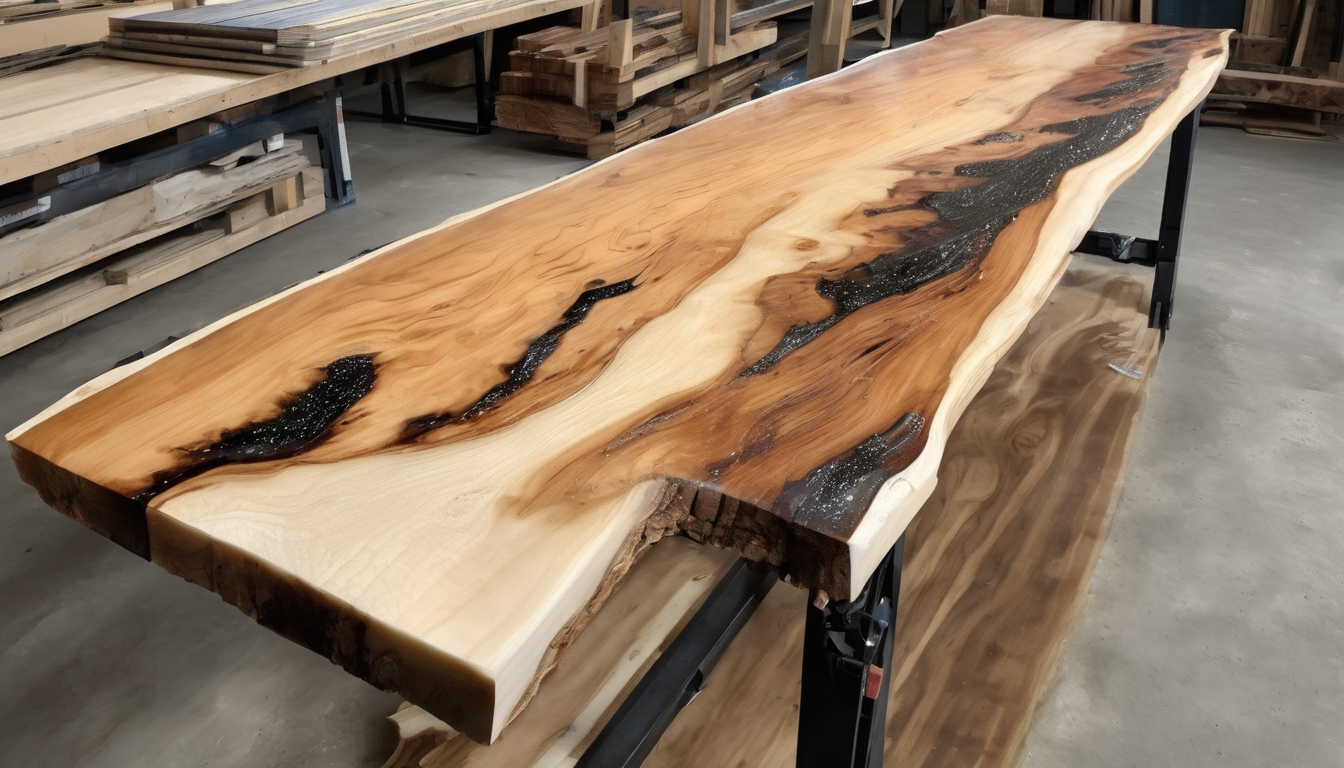

Creating a stunning river table starts long before the epoxy goes in — learning How to Prepare Timber Slabs for Epoxy River Tables ensures a durable bond, fewer bubbles and a professional finish. This guide walks you through each essential stage: assessing and drying slabs, removing bark and loose material, stabilising cracks, sealing and dry-fitting the wood in a mould so your epoxy pour goes smoothly.
Introduction: Why Prepare Slabs
Proper preparation of timber slabs prevents trapped moisture, air and loose fibres from causing bubbles, poor adhesion or structural failure in the cured epoxy. Learning How to Prepare Timber Slabs for Epoxy River Tables reduces rework, keeps costs down and helps produce a table that lasts decades rather than years.
Understanding How to Prepare Timber Slabs for Epoxy River Tables
Before you begin, understand that timber behaviour determines epoxy performance: moisture content, movement, decay and surface cleanliness are the main variables to control. This section explains those variables and why each preparation step matters. This relates directly to Prepare Timber Slabs For Epoxy River Tables.
Moisture content and movement
Epoxy bonds well to dry timber; most makers recommend below 8–12% moisture content for river tables to limit voids and future movement. Kiln-dried slabs are best for stability, while green or high-MC timber risks expansion, blistering or lifting of epoxy. When considering Prepare Timber Slabs For Epoxy River Tables, this becomes clear.
Surface bonding and contamination
Bark, dust, sap and loose fibres trap air and prevent a clean bond. Thorough cleaning and a light pre-seal reduce bubble formation during pours and strengthen the edge bond with the epoxy. The importance of Prepare Timber Slabs For Epoxy River Tables is evident here.
Prepare Timber Slabs For Epoxy River Tables: Materials & Requirements
- Moisture meter (pin or pinless) for MC readings
- Planer or thicknesser, or large belt/hand plane
- Belt sander / orbital sander (grits 80–240)
- Chisels, wire brush and small grinders for bark removal
- Vacuum and clean compressed air
- Epoxy-compatible stabiliser or thin CA glue for crack stabilisation
- Low-viscosity epoxy or seal coat (brand chosen below)
- MDF/melamine for a leakproof mould, clamps and caulk
- Personal protective equipment: respirator rated for organic vapours, gloves, eye protection
Prepare Timber Slabs For Epoxy River Tables – Step 1 — Assess, Measure Moisture & Dry
- Check the slab visually for rot, insect damage and large structural defects; discard or splice out seriously decayed sections.
- Measure moisture content across the slab at several points (heartwood, sapwood, near the edge). Aim for below 8–12% MC depending on your epoxy and local humidity — in UK coastal or damp areas like Bristol or Plymouth aim for the lower end and allow extra drying time.
- If MC is too high, air-dry in a covered, ventilated area on stickers with weight on top to control cupping. For faster results use a kiln or heated workshop set to 20–30°C, monitoring for cracking.
- Expect drying to take weeks or months depending on thickness; don’t rush — inadequate drying is a common mistake that costs far more later than storage space.
Step 2 — Clean, Remove Bark & Stabilise Edge
- Remove all loose bark and friable sapwood. Use chisels, a drawknife or a small grinder with a flap wheel for delicate edges. Live bark often hides pockets that trap air — remove it fully where epoxy will contact the void.
- Clean the live edge using a wire brush and compressed air to eject dust and tiny fibres that cause micro-bubbles once sealed.
- Where you want to preserve character, leave solid, well-bonded bark only as a decorative element but do NOT allow loose bark into the epoxy channel.
- Apply a light sanding (80–120 grit) to create a keyed surface for the epoxy to grip; finish with 180–240 grit on glue surfaces to remove roughness without glazing the timber.
Step 3 — Repair and Stabilise Cracks/Voids
Cracks and checks are part of the slab’s character but must be stabilised to prevent epoxy leaks or structural weakness. Understanding Prepare Timber Slabs For Epoxy River Tables helps with this aspect.
Small cracks and hairline checks
- Inject thin CA glue or low-viscosity epoxy into hairline cracks and clamp/open slightly to allow penetration. Wipe excess; repeat if necessary.
- For insect holes or pockets, clean thoroughly and fill with epoxy or coloured filler if you plan to encase them in the river. Use a pigmented epoxy or wood filler to match surrounding timber if you prefer invisibility.
Large voids and structural splice repairs
- For large rot pockets or missing sections, consider a splice-in of matching timber using a dovetail or tapered scarf joint for structure, then fill remaining voids with epoxy.
- Reinforce structural joins with biscuits or dowels if the table will bear weight, especially for dining tables and benches.
Step 4 — Flatten, Joint Faces & Dress Edges
- Flatten faces that will sit in the mould using a planer, router sled or wide belt sander so the slab sits true in the form and prevents low spots that concentrate epoxy.
- Joint any mating faces so the grain alignment and gap between slabs is consistent; consistent gap width helps predict epoxy volume for cost and cure planning.
- Dress the underside if you plan to epoxy from below as well; a flat underside simplifies final flattening and sanding after cure.
Step 5 — Seal (Precoat), Dry-fit and Final Checks
- Apply a thin seal coat (also called a “pore coat”) of the same epoxy system you’ll pour — mixed at the correct ratio but thinned to a low-viscosity if manufacturer allows — to all porous surfaces to reduce gas release during the main pour. Allow tack-cure per manufacturer instructions.
- Use tape and silicone to temporarily dam the underside holes or loose sections where uncontrolled leaking could occur during the pour.
- Dry-fit the slabs inside your mould, clamp gently to the base so they cannot float, and check for level with a 2m spirit level. Mark high and low spots and address them now with a light sand or shim.
- Calculate epoxy volume: measure the gap area and depth to order the correct litres of deep-pour epoxy (allow 10–15% contingency for waste and absorbency of fresh wood). In the UK, deep-pour epoxy typically costs between £X,XXX.XX and £X,XXX.XX for large projects depending on brand and volume — get quotes locally and factor shipping and VAT.
Common Epoxy Mistakes in River Table Builds and Fixes
- Skipping moisture checks: leads to popping and delamination — measure and, if needed, dry further.
- Insufficient pre-seal: causes micro-bubbles — always pre-seal porous timber.
- Using the wrong epoxy: non-deep-pour epoxy overheats or yellows in deep pours — choose a deep-pour, low-exotherm system for thick rivers.
- Not clamping wood: wood floats — secure slabs but allow minor movement for shrinkage.
What Brand of Epoxy Is Best for a River Table Project & Pouring Techniques
Choose a reputable deep-pour epoxy formulated for low heat and clarity; many professionals favour brands such as Stone Coat Super Clear, EcoPoxy UVPoxy/EP series and UltraClear (product ranges vary by region). These brands offer deep-pour formulations and tabletop coatings suitable for multi-layer pours and have extensive technical data to guide cure time and layer thickness[1][2]. Prepare Timber Slabs For Epoxy River Tables factors into this consideration.
Pouring tips:
- Work at a stable workshop temperature (ideally 18–22°C) to control cure speed and bubble behaviour[4][2].
- Mix slowly and thoroughly, scraping sides and bottom; pour in stages for depths beyond the manufacturer’s single-pour limit to avoid overheating[4][2].
- Use a heat gun or propane torch quickly over the surface to pop bubbles immediately after pouring; avoid prolonged flame exposure that can yellow the resin.
- Allow full recommended cure between layers; sanding between layers improves adhesion for subsequent pours.
Expert Tips & Key Takeaways
- Always start with a moisture meter — that single read will save weeks of heartbreak later.
- Pre-seal porous areas using the same epoxy system to reduce trapped air and improve clarity[6].
- If you’re working in damp UK regions such as Cornwall, Dorset or Somerset, add extra drying time and store slabs off the ground on stickers inside a ventilated shed.
- Keep detailed notes of epoxy lot numbers, mix ratios and ambient temperature for each pour — invaluable if you need to troubleshoot later.
Conclusion
How to Prepare Timber Slabs for Epoxy River Tables is a discipline of patience and attention to detail: dry the wood properly, remove loose bark, stabilise and repair voids, flatten mating faces, and pre-seal before pouring. These steps reduce bubbles, avoid structural issues and help you achieve the clear, glass-like river that makes this craft so striking. With careful preparation and the right epoxy system, your river table will be both beautiful and long lasting.
